
Zero Brokerage. Always.
Unlike traditional brokers, Qdesq never charges the occupier. Our platform is completely free for workspace seekers — forever.
India's largest flexible workspace platform. 6,000+ enterprise-grade centres across 140+ cities. Find, compare, and launch your GCC workspace — zero brokerage, zero hassle.

World's GCCs are based in India
From Cost to Command Centre
Global GCC talent sits in India
Mandates now owned end-to-end

Traditional fit-outs take 6–12 months. Flex spaces are move-in ready – plug in, start building in 90 days.

Scale from 50 to 500 seats, no new lease needed. CRE should breathe with your business.

60% of GCCs choose green-certified Grade A flex. Premium infrastructure is a talent retention strategy.

Biometric access, CCTV, segregated networks, visitor systems – compliance-ready for global data sovereignty.

Bengaluru talent, Mumbai clients, Pune team – one platform, one invoice, 140+ cities covered.

Shift real estate from CapEx to OpEx. Save 15%+ via Qdesq negotiation. Better balance sheet flexibility.
of India’s Grade A office leasing is driven by GCCs
Projected GCC market
size by 2030
GCCs operating in
India today
of GCC employees prefer premium workspaces
Private, build-to-suit spaces with dedicated infrastructure. Your brand, culture, security — managed end-to-end so you focus on your team.
HQ in a primary city, satellite offices across India. Single billing, unified management — Bengaluru, Hyderabad, Delhi-NCR, Pune, Chennai, Mumbai.
6,000+ workspaces on pay-per-use. Day passes, hot desks, private cabins — wherever your people are, a workspace waits.
Zero downtime, zero blocked real estate. Pre-identified backup spaces across cities and micromarkets — activated on demand.


Let our team help you find the right office for your needs.


Share your city, seat count, and compliance needs. Our experts handle the rest.

We filter 6,000+ Grade A, green-certified centres to find your perfect GCC-standard match.

Visit top options and compare terms. We secure rates 15% below the market average.

Launch with one invoice across all cities via Qdesq’s centralized platform.

Unlike traditional brokers, Qdesq never charges the occupier. Our platform is completely free for workspace seekers — forever.

6,000+ centres across 140+ cities. No other platform gives you this breadth. Find exactly what you need, where you need it.

Our workspace advisors negotiate 15% off the listed price on average. Enterprise-grade deal structuring for leases from 1 to 5 years.

Qdesq's platform centralises end-to-end operations, allowing you to manage multi-city portfolios with a single, unified invoice, simplifying accounts payable.
Centers listed
Corporate partners served annually
Cities

10 MSF+ demand
Gurgaon & Noida

BKC & Powai
BFSI & Consulting

Hinjewadi & Kharadi
ER&D Auto hub

900+ GCC units
34-39% market share

OMR Tech Corridor
IT & Manufacturing

20-23% GCC market
BFSI & Analytics hub
We needed 200 seats across 3 cities in under 90 days. Qdesq delivered shortlists within a week and we were operational in 60 days. Their multi-city coordination is unmatched.
Zero brokerage isn't a gimmick — it's real. The savings on our 400-seat Bengaluru setup were substantial. Qdesq's negotiation team genuinely fights for the occupier.
The breadth of inventory is what sold us. We compared 40+ options across Hyderabad micromarkets on one platform. That's impossible with a traditional broker.
Trusted by thousands of businesses across India
Centers
Listed
Cities
Covered
Desks Booked
Monthly
Talk to a Office Experts

We pre-vet all centres for Grade A compliance, verifying top-tier features like biometric access, 24/7 CCTV, segregated networks, and robust visitor management systems for global data security.
Yes. Our Managed Office is a customizable "build-to-suit" solution that provides a private, branded space tailored to your specific culture, layout, and infrastructure, all backed by our full facility management.
Cut your time-to-go-live to under 90 days. We leverage 6,000+ pre-vetted, enterprise-grade centers to deliver instant, move-in-ready workspaces, beating the traditional 6–12 month lease cycle.
Our transparent marketplace is entirely free for workspace seekers. We earn revenue directly from providers, allowing us to serve as your dedicated negotiator without charging any brokerage fees to your CapEx or OpEx.
Absolutely. This is a core capability. We simplify accounts payable across your multi-city portfolio—including Tier-2 satellite offices—by providing one unified invoice.
We secure pre-vetted backup spaces across micromarkets or cities that can be activated on demand, ensuring zero downtime for global operations during disruptions.
Handling 65k+ desk bookings monthly gives us collective bargaining power. Our experts know the "real" floor price across 140+ cities, ensuring you access enterprise-grade terms individual occupiers rarely receive.
Qdesq Proptech Group is a comprehensive commercial real estate technology ecosystem that streamlines the workspace lifecycle. It comprises two primary pillars:
Sustainability is a priority for 60% of our GCC clients. We filter for green-certified, LEED, or WELL-rated buildings to align your local footprint with global ESG mandates.
The talent market is shifting. With inventory in 140+ cities, including emerging hubs, we provide instant access to Grade A spaces—from satellite offices to day-passes—where traditional sourcing is challenging.

Flexible shared workspaces designed for teams and individuals to work.
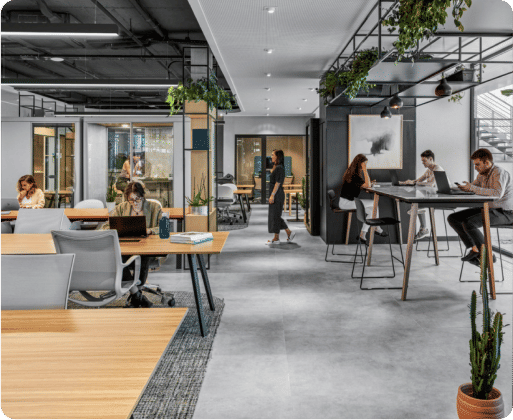
Private, ready-to-use office space with all amenities and support included.

Fully equipped professional rooms for client meetings, team discussions.

Flexible, affordable day passes and monthly plans.
A Global Capability Centre (GCC) is an offshore unit that a multinational company operates directly — not through a third-party vendor — to run strategic functions such as R&D, engineering, and analytics.
Something changed in the first quarter of 2026 that most workspace conversations still haven't caught up to: Global Capability Centres accounted for 45.5% of all office leasing in India in Q1 2026 alone — the highest share on record for any single occupier category (JLL India, Q1 2026 Office Market report). Flex space surpassed 100 million square feet of stock in the same quarter (Cushman & Wakefield, June 2026), and GCCs are now the single biggest driver of demand behind that number too.
Finding the right workspace for your India centre isn't a market that's growing quietly anymore — it's a market being rebuilt around one occupier type. And the GCCs winning that rebuild aren't choosing between a managed office and flex space, or between Bengaluru and a tier-2 city, on instinct. They're running the cost math, checking what their state is subsidising, confirming their ESG exposure, and only then signing anything.
Here's what that actual decision-making process looks like in 2026 — the data, the policy landscape, the real numbers behind “cheaper,” and the framework GCC leaders are using to find the right workspace for their India centre the first time, not the third.
For a step-by-step setup walkthrough, check out How to Set Up a GCC in India: The 2026 Strategic Playbook for Global Enterprises.
Read those together and the picture is unambiguous: demand for GCC office space is up, supply of quality space is tightening, and flex isn't a fallback option anymore — it's structurally embedded in how serious occupiers plan real estate. A GCC in India negotiating its workspace strategy today is negotiating in a tightening market, not a buyer's market. That changes the calculus on waiting. For a sharper look at what's real and what's hype in this boom, see analysis: India's GCC Boom — The Real Story.
The phrase that's replaced “cost savings” in every serious GCC strategy conversation this year is capability arbitrage — the idea that Indian centres aren't executing someone else's roadmap anymore; they're building it. Indian GCCs now employ over 126,600 professionals in AI-aligned roles, and more than half of them function as transformation hubs rather than execution outposts.
Roughly 58% are actively investing in agentic AI workflows, and 83% are scaling generative AI projects in production, not in pilot.
This matters for office space in an easy-to-miss way: a team running agentic AI workflows and a team doing back-office processing don't need to be on the same floor. Compute-adjacent infrastructure, security clearances for IP-sensitive work, and the kind of client-facing, brand-forward space that reassures a global HQ visiting for a model governance review — these are real estate requirements now, not nice-to-haves. The shift from labour arbitrage to capability arbitrage is also a shift in what GCCs need from their office space: from “any decent floor will do” to “this specific floor needs to do a specific job.”
It's also pushing up the cost of the talent that the floor needs to house. See Qdesq's analysis: What India's GCC Talent Crisis Actually Means for Salaries.
GCC real-estate decisions are no longer just landlord conversations; they are policy conversations. State governments are actively bidding for your centre.
A 50% rental reimbursement can make managed office space in Mysuru cheaper than unsubsidized flex space in central Bengaluru. Locking in your GCC's city or real estate without checking active state subsidies means leaving money on the table before negotiations even begin.
For the full state-by-state breakdown of which incentive actually moves the needle, check out this analysis: GCC Policy Incentive India 2026 — Which One Actually Pays Off.
Every conversation about GCC office space eventually lands on cost, and this is where most comparisons get lazy — they compare rent per square foot and stop there. The real number CFOs need is the total cost of ownership, and on that measure, the traditional lease almost never wins for a team with fewer than a few hundred seats.
For a 300-seat team in a Grade A Bengaluru building, a traditional lease typically requires a security deposit of six to twelve months' rent plus fit-out capital in the range of ₹4.5 to 10.5 crore — committed entirely before the operation produces a single output. Under a Bangalore-managed office model, that deposit drops to one to two months, and fit-out capital is effectively zero, because the infrastructure is already built and amortised into the monthly fee. The capital that is freed up is capital that a GCC can redirect toward talent acquisition and technology infrastructure during the exact window when those investments matter most.
Qdesq's own platform data across enterprise GCC deployments backs this up at scale. GCCs that have scaled aggressively on managed infrastructure report consistent patterns: multi-thousand-seat deployments across two to three cities, each location lives in 50 to 120 days, and are frequently delivered 15–20% below the budget that a traditional build-out would have required. That's not a marginal efficiency gain — it's the difference between a real estate line item and a strategic lever.
See the full breakdown in Qdesq Insights' How Enterprises Are Shifting From Traditional CapEx Models to Flexible Workspaces 2026.
For any GCC reporting up to a US, UK, or EU parent company, the sustainability profile of its office space has quietly moved from “nice to have” to “audit requirement.” The EU's CSRD now requires European parent firms to disclose sustainability performance across their global operations, making ESG-compliant office space for Global Capability Centres in India a compliance issue rather than a branding one. Leased offices fall under Scope 3 emissions reporting, so GCCs working toward Science Based Targets initiative (SBTi) commitments need their India real estate to actually carry the data to back it up.
The market is responding quickly: more than three-fourths of newly completed Grade A office space in India is now green-certified (Colliers' India Office Market Demand Forecast, 2026), and Indian developers are increasingly aligning with global benchmarks such as GRESB to stay relevant to international occupiers. For a GCC, this means the green certification on your shortlisted building isn't a checkbox — it's a number your parent company's sustainability report will eventually need to cite.
For the full compliance checklist, see GCC Office Space Requirements: Compliance, Security & Scalability.
Set against this backdrop — tightening supply, state subsidies, AI-driven mandate shifts, and ESG audit requirements — the managed-office-versus-flex question is no longer theoretical. A managed office is a private, fully built-out workspace operated end-to-end, giving lease-like control without the capital outlay or fit-out timeline.
Flex space is workspace on demand: shared or private, no long-term commitment, built for speed and uncertainty rather than customisation.
Neither wins outright in 2026. Flex is growing 77% year-on-year because GCCs use it for what it's good at: speed, overflow, and market-testing in a new city. Managed office absorbs 40–50% of Grade A demand because it's what GCCs use for what they're certain about: the anchor team, the brand-forward floor, the compliance-ready, audit-friendly footprint.
| Managed Office | Flex / Coworking | |
|---|---|---|
| Best for | Core team, known headcount | New city, uncertain team size |
| Commitment | Longer term, high confidence | Short-term, scale anytime |
| Setup time | 60–120 days | Move-in ready |
| Upfront capital | Near-zero fit-out, 1–2 months deposit | None |
| State incentive fit | Often eligible for rental or capital subsidies | Rarely covered by state policy |
| ESG / compliance documents | Built-in, audit-ready | Varies by operator |
| Ideal seat count | 50+ seats | Under 50 seats, or overflow |
The real question isn't “managed office vs. flex.” It's: what do you know for certain about your team, and where does your state's policy — or your parent company's ESG mandate — make one option the financially and strategically smarter call? See Managed Office vs Coworking for GCCs: What's the Right Fit?
Once a GCC decides that a managed office is the right fit for its anchor team, the next question is which provider category best fits the mandate. India's managed office landscape for GCCs has matured into a handful of distinct, credible categories — each suited to a different scale and certainty profile.
The problem most GCCs run into isn't a shortage of options — it's the opposite.
Evaluating four or five operator categories across six shortlisted cities, each with different pricing models, lease structures, and compliance documentation, turns a real estate decision into a six-month procurement project.
This is precisely the gap Qdesq closes. Instead of running parallel RFPs with individual operators, Qdesq's platform puts managed office and flex inventory from every major category — large-format enterprise operators, tech-enabled flex brands, regional specialists, and boutique providers — on one comparison screen, pre-vetted for Grade A standards, security compliance, and ESG documentation, so your team evaluates one shortlist instead of five separate vendor pitches.
BMW Techworks India scaled from 100 to 700 seats managed office space in Pune in just 120 days, using managed office infrastructure instead of a ground-up buildout — a timeline a traditional lease and custom fit-out would have stretched to 9–12 months. That speed is becoming the standard, not the exception, because the GCCs winning right now run a managed office core for their anchor function and layer flex space around it for everything uncertain: hiring spikes, pilot teams, hybrid overflow.
This hybrid structure is also where India's GCC office space map is physically moving. Tier-2 cities accounted for just 5% of new GCCs in 2019; that share reached 7% by 2024, and industry forecasts — including the NASSCOM-Zinnov India GCC Landscape Report — project it crossing 25–30% by 2030 — driven by tier-2 locations carrying a 25–30% cost advantage over tier-1 cities, alongside deeper, lower-attrition talent pools. A portfolio that breathes isn't just about flexing seat count anymore. It's about flexing geography, city by city, as state incentives and talent availability shift. Read more in Beyond Bengaluru: The Strategic Imperative for Tier-2 GCC Expansion.
See the full ranked breakdown in Top 7 Markets for GCC Offices in India (2026). Explore coworking spaces and serviced offices across each of these markets.
Before signing anything, five questions should drive the decision:
Most GCC real estate mistakes trace back to skipping questions four and five — signing a market-rate lease in a city actively subsidising rent for exactly your profile, or discovering eighteen months in that the building's sustainability documentation can't support a global ESG audit.
Qdesq is India's largest workspace marketplace — 6,000+ centres across 140+ cities, zero brokerage for occupiers, ever. For GCCs specifically, that means:
No two GCCs need the same mix of managed and flex office space. Qdesq builds the mix around your headcount certainty, your state's incentive map, and your compliance requirements — not a template.
Behind the platform is a dedicated team that does this for a living — not a generic brokerage desk handling GCCs as one category among many. A few things that make their intelligence genuinely useful to a GCC decision-maker:
There isn't a single best option — the right office space for a Global Capability Centre depends on headcount certainty, timeline, and compliance needs. Most scaling GCCs use a hybrid model: a managed office as the anchor for their core team, with flex space absorbing overflow and pilot teams.
GCCs accounted for 45.5% of all office leasing in India in Q1 2026 (JLL India), and are projected to drive 40–50% of total Grade A office demand for the full year.
For most teams above 50 seats, yes, on the total cost of ownership. A traditional lease for a 300-seat Bengaluru team typically requires ₹4.5–10.5 crore in deposit and fit-out capital before operations begin; a managed office reduces that to one to two months' deposit with effectively zero fit-out cost.
Yes. States including Karnataka, Telangana, Uttar Pradesh, Haryana, and Odisha now offer dedicated GCC policies with rental reimbursements up to 50%, capital subsidies up to ₹50 crore, and fast-tracked approval timelines, often tied to specific cities within the state.
For GCCs reporting to US, UK, or EU parent companies, leased office space falls under Scope 3 emissions reporting requirements set by frameworks such as the CSRD and the SBTi. A green-certified, audit-ready building is increasingly a compliance requirement, not just a sustainability preference.
With pre-built, pre-vetted managed office infrastructure, GCCs can typically go live in 60–120 days, compared to 9–12 months for a traditional lease and custom fit-out.
Bengaluru, Hyderabad, Delhi-NCR, Pune, Chennai, and Mumbai host the majority of GCCs today, while Indore, Coimbatore, Vadodara, Ahmedabad, and Bhubaneswar are the tier-2 cities with the strongest current infrastructure readiness.
Yes — this hybrid model, a managed office core with flex overflow, is increasingly the default, allowing GCCs to absorb hiring spikes and pilot teams without having to renegotiate a lease each time.
No. Qdesq's platform is completely free for workspace seekers — the company earns revenue from providers, not occupiers.
Tell us your headcount certainty, your timeline, and your shortlisted states. We'll show you exactly where managed office ends, where flex begins, and which incentive applies — for your business specifically.